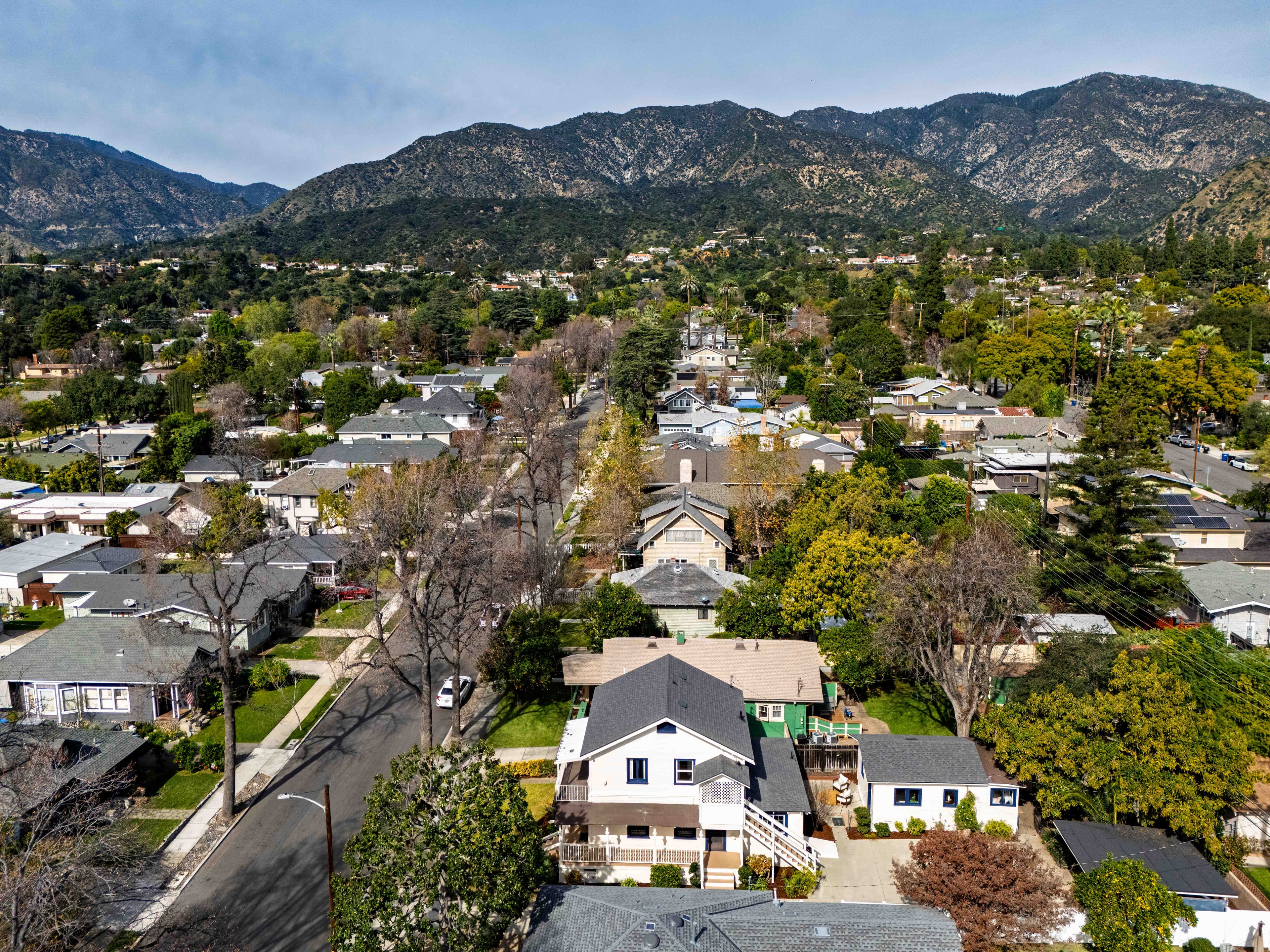
Monrovia, California
Monrovia Real Estate
Old Town charm, foothill views, and the most character-rich entry point into the SGV.
Monrovia is the foothill city people fall in love with and then refuse to leave. Nicknamed the “Gem City of the Foothills,” it sits at the base of the San Gabriels between Arcadia and Duarte — a walkable Old Town, historic Craftsman neighborhoods, a weekly street fair that’s been running for decades, and hiking trailheads you can actually walk to from your front porch. For buyers priced out of Pasadena or Arcadia but unwilling to give up character, Monrovia is one of the most compelling markets in the San Gabriel Valley.
Jennifer currently represents listings in Monrovia and works with buyers across every corner of the city — from the historic blocks north of Foothill to the flats of South Monrovia and the newer foothill builds above Hillcrest. If you want the SGV’s character and foothill lifestyle without the pricing pressure of its larger neighbors, this is where to start.
Homes for Sale in Monrovia
Jennifer currently represents Monrovia listings, and character homes in the historic core often move fast when they hit the market. Reach out for current inventory, upcoming listings, and off-market opportunities — particularly Craftsman and Mills Act-eligible properties.
About Monrovia Real Estate
Monrovia’s real estate market is one of the most architecturally interesting and attainable in the San Gabriel Valley. The city covers roughly 13 square miles, runs from the San Gabriel Mountains in the north down to the 210 freeway and beyond, and carries a housing stock that ranges from 1890s Victorians to brand-new foothill builds.
The market breaks down into three rough sub-areas. North Monrovia, above Foothill Boulevard, is the city’s premium zone — historic homes, larger lots, foothill views, and proximity to hiking trails. It also contains much of the city’s newer custom construction. Central Monrovia, around Old Town and Myrtle Avenue, is the walkable heart of the city and contains some of the most significant historic neighborhoods, including the North Myrtle Historic District and concentrations of Craftsman, Victorian, and Spanish Colonial Revival homes. South Monrovia, south of the 210, has a mix of ranch homes, mid-century properties, more affordable price points, and proximity to the Station Square development around the Metro A Line station.
Monrovia’s historic districts carry meaningful design review standards, and many qualifying homes are eligible for the Mills Act — the California preservation program that offers reduced property taxes in exchange for maintenance and preservation commitments. Monrovia has one of the more active Mills Act programs in the region, and for the right buyer, that’s a real financial advantage.
Price ranges are generally more attainable than Pasadena or Arcadia. Entry-level condos and townhomes can trade well under $700K. Craftsman and character homes in the historic core typically list between roughly $900K and $1.8M, depending on size, condition, and Mills Act status. Larger homes and newer foothill builds in North Monrovia can trade well into the $2M+ range.
For buyers, Monrovia offers the rare combination of character, walkability, foothill access, and reasonable entry points into single-family ownership. For sellers, it’s a market where a well-prepared, correctly priced home attracts real competition — especially when it’s in a historic district or has Mills Act eligibility. Jennifer understands the details that move the needle in both directions.
Living in Monrovia
Monrovia has one of the best walkable downtowns in the San Gabriel Valley. Old Town Monrovia runs along Myrtle Avenue north of Foothill Boulevard and is lined with independent restaurants, bakeries, coffee shops, wine bars, boutiques, and civic buildings. Locals and visitors actually walk here — the sidewalks fill up in the evenings, and on Friday nights the Monrovia Street Fair and Certified Farmers’ Market turns the street into a pedestrian fair with live music, food trucks, produce vendors, and craft booths. It’s one of the longest-running community events of its kind in Southern California.
For outdoor life, Monrovia is almost uniquely well-positioned. Monrovia Canyon Park sits just north of town, with a waterfall hike that’s become a local institution. The Sawpit Canyon trail system, Ben Overturff Trail, and access into the Angeles National Forest all start at the top of the city, which means serious hiking is a short drive — or walk — from many Monrovia neighborhoods. The Monrovia Wilderness Preserve protects a large area of foothill terrain above the city.
The Library Park area, just east of Old Town, is home to the Monrovia Public Library, community recreation facilities, and a splash pad that tends to draw half the city’s kids on summer afternoons. Recreation Park in South Monrovia offers ball fields, tennis and basketball courts, and a community pool.
Culturally, Monrovia balances its history with a modern, independent small-business scene. The city has invested consistently in historic preservation, walkability, and public events, and it shows. For a city of roughly 37,000, the lifestyle density is unusual — you can live here without a long daily commute to a different city for food, errands, or community.
Day to day, Monrovia feels like a place where life is a little slower, neighbors still talk to each other, and the mountains are part of every view.
Homes and Architecture in Monrovia
Monrovia’s housing stock is one of the most character-rich in the San Gabriel Valley. The city’s earliest homes date to the 1880s and 1890s, and a meaningful number of those Victorian and Queen Anne properties still stand, particularly in the historic core along and near North Myrtle.
The Craftsman bungalow is probably Monrovia’s most recognizable housing style. Built primarily between 1900 and 1925, Craftsmans fill entire blocks of central Monrovia and the neighborhoods immediately north and south of Old Town. Many are original, with the exposed rafter tails, built-in cabinetry, fireplaces, and wide front porches that define the style.
Spanish Colonial Revival and Mediterranean homes arrived in the 1920s and 1930s, and they still anchor stretches of North Monrovia and parts of the historic core. Mid-century ranch and traditional homes filled in South Monrovia and much of the foothill expansion from the 1950s onward.
In the foothills above Foothill Boulevard, newer custom builds have reshaped some streets — larger footprints, contemporary styling, and deeper lots. The North Myrtle Historic District, Wild Rose Historic District, and other landmark neighborhoods carry design review requirements that protect the original character of their streetscapes.
The Mills Act is active in Monrovia and applies to many qualifying historic homes. For buyers looking at a historic property, Mills Act eligibility can meaningfully reduce annual property taxes in exchange for preservation commitments. Jennifer can help identify which listings qualify and walk you through the details.
Schools in Monrovia
Monrovia Unified School District (MUSD) serves Monrovia, Bradbury, and portions of Arcadia and Duarte. The district operates a mix of neighborhood elementary schools, Clifton Middle School, and Monrovia High School, along with specialized programs and an alternative high school.
Monrovia Unified has long been a community-focused district with strong parent and civic involvement. Families who prioritize a close-knit, neighborhood-school environment often find MUSD a good match. Specific attendance boundaries within the district affect elementary placement, and some boundaries are more competitive than others for incoming families.
Private school options in and near Monrovia include Clairbourn School in nearby San Gabriel, Sequoyah School in Pasadena, and several faith-based K–8 programs within Monrovia itself. Families who want access to Pasadena’s deeper private school ecosystem — Polytechnic, Chandler, Mayfield, Westridge — live a short drive west, which is a common pattern for Monrovia residents.
Higher education is close by. Pasadena City College is roughly 15 minutes west, Citrus College in neighboring Glendora is 10 minutes east, and California State University, Los Angeles is accessible via the 10 freeway.
If schools are part of your Monrovia search, Jennifer can walk you through the attendance boundaries, program options, and how they line up with specific neighborhoods.
Frequently Asked Questions About Monrovia Real Estate
What's the average price of a home in Monrovia?
Monrovia is generally more attainable than Pasadena or Arcadia. Condos and townhomes can trade below $700K, Craftsman and character homes in the historic core typically list between roughly $900K and $1.8M, and larger foothill properties can trade above $2M.
Where are Monrovia's best neighborhoods?
North Monrovia (above Foothill Boulevard) is the premium zone, with historic homes, newer foothill builds, and views. Old Town and North Myrtle Historic District are the heart of the walkable historic core. South Monrovia offers more affordable entry points and proximity to the Metro A Line station. The right neighborhood depends on your priorities.
Is Monrovia a good place to raise a family?
Yes — it's one of the most family-friendly cities in the eastern SGV. A walkable downtown, strong community events, accessible outdoor recreation, and an engaged school district are all part of the draw.
Can I still find a Craftsman bungalow in Monrovia?
Yes. Monrovia has one of the densest concentrations of original Craftsman homes in the San Gabriel Valley, with particularly strong inventory in the North Myrtle Historic District and surrounding blocks. Well-preserved Craftsmans in good condition move quickly when priced correctly.
What is the Mills Act and does it apply in Monrovia?
The Mills Act is a California historic preservation program that allows owners of qualifying historic homes to receive a reduced property tax assessment in exchange for a long-term commitment to maintain the home's historic character. Monrovia has an active Mills Act program, and many homes in historic districts qualify. Jennifer can identify which listings are Mills Act-eligible and walk you through the tradeoffs.
What's the commute like from Monrovia to downtown LA or Pasadena?
Typically 30–45 minutes to downtown LA depending on traffic and route, and 15–20 minutes to Pasadena. The Metro A Line stops at the Monrovia Station in Station Square, making car-free commuting to Pasadena, downtown LA, and beyond a realistic option.
What's the Monrovia Street Fair?
It's a long-running weekly pedestrian fair held on Friday nights along Myrtle Avenue in Old Town. It combines a certified farmers' market, food vendors, live music, kids' rides, and a community gathering atmosphere. For many Monrovia residents, it's a standing Friday plan from spring through fall.
How do I get started working with Jennifer on a Monrovia home search?
Reach out through the contact form on this page, email directly, or call. Jennifer will follow up personally — usually same day — to talk through your priorities, timeline, and the Monrovia neighborhoods that fit.
Explore Nearby Cities

Work with a Monrovia specialist
Jennifer Lang — Realtor | The Dillsaver Group | Berkshire Hathaway Home Services. If you’re buying, selling, or just thinking about your options in Monrovia, reach out directly. Jennifer follows up personally, usually the same day.